
Yoga Bliss Blog
by Julie on Apr.22, 2013, under Yoga Retreat
The Value of Home Practice
Lately, I have had a few really wonderfully connected home yoga practices. It’s not always that way. But after listening deeply to what my body needs in my Authentic Movement cohort ( a group of woman peers who have been meeting monthly for about 7 years now), I have been able to translate that witnessed experience to the unwitnessed one at home.
When you enter a yoga studio class you become “witnessed.” On the positive side, this means the teacher watches and cares for you and your body/emotions during class. On the not so positive side, this can mean you may feel judged by teacher or fellow students, self-conscious, shy, competitive, seek attention, etc. When we practice solo we really get to attend to our moment to moment body needs. We practice deep listening without the pressure to perform. It’s a little bit like a young child who can plays alone. Do you remember those times? How deeply satisfying it was to be within your own uninterrupted play space? Home practice can be like that. Joyful and connected. Sometimes the meaning of yoga becomes so much clearer in this quiet alone space. Today, I was moved to tears by our human incarnation-I discovered this again through my body moving alone at my own pace.
Being Witnessed can also be wonderful and enlightening. This is what I try to pass onto my private students and clients- the safety of being in the body or practicing yoga with support and care.
India Retreat Re-cap
by Julie on Mar.27, 2013, under Yoga Retreat
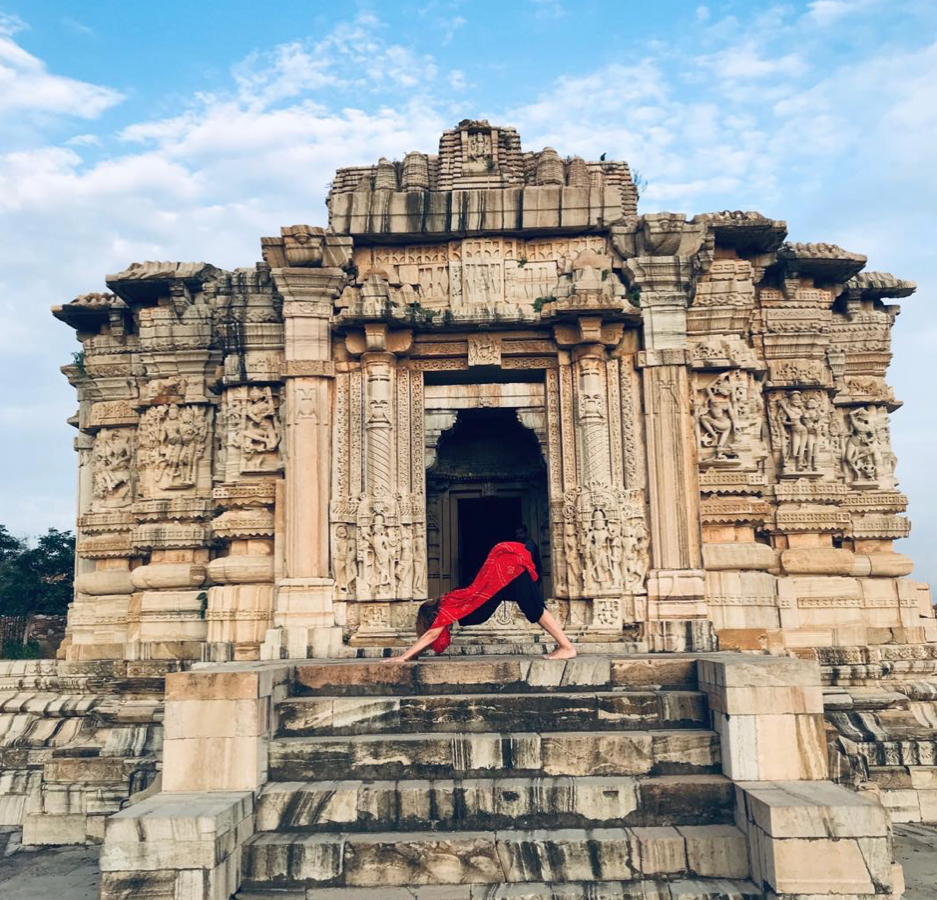
Here are some pics from our recent yoga retreat to Goa, Hampi. Join us for our next exciting voyage. 
Guest Blog India/ Hampi
by Julie on Sep.17, 2012, under Yoga Retreat
Our guest writer Abbas, from www.indiasomeday.com offers our yoga group some invaluable info on Hampi as well as traveling on after Hampi. We will be traveling to Hampi together by train but at the end of this portion of the retreat you will want to decide how to return to Goa/Mumbai/Bangalore. Options are listed below. Many will head right back to the Goa airport to fly into your next destination. Or you can take a bus all the way back to Mumbai/Bombay. We will help you arrange this. In fact contact Abbas directly for more route information.
About Hampi
Hampi is a mesmerizing, pretty town of boulders and ruins. I remember a close traveller friend telling me ‘enjoy your first of many trips to Hampi’ as I boarded my Bombay-to-Hospet bus. Set in a boulder strewn landscape that continues forever, bisected by a meandering river and dotted by banana plantations, Hampi can be explorative, adventurous or plain relaxing, depending on how you want it to be. Unlike a lot of old Indian towns Hampi, fortunately, was abandoned centuries ago never to be inhabited again, saving it from being defaced by an ugly ‘messopolis’ Indian town being build around it. Hampi truly feels like an open-air museum left for you to discover on foot, bicycle or motorbike.
Do:
Hampi has many gorgeous temple structures to explore. A guide is recommended to get a deeper understanding of the history of the town. Even if you are not a history buff, you can just walk around admiring these structures. Remember, Hampi is well spread out and apart from the cluster of places to stay and restaurants on either side of the river it offers a keen sense of space wherever you wander. Hampi is certainly best explored on cycle and motorbike. We did a combination of foot, bicycle and motorbike (motorbike hire works just like Goa).
Experiences we recommend:
—Take the effort to wake up before sunrise, trek up to Mantunga hill and watch the sunrise over the magical kingdom of Hampi. The boulders are all red and they just light up in the sunlight (the most breathtaking experience during my stay).
—Catch the sunset as you sit by the river.
—Cycle around. A motorbike really allows you the flexibility to explore and ride beyond Hampi into the countryside
—Enjoy your meals with the view of the river and the omnipresent, majestic boulders which are beautiful, some three stories tall and precariously balanced.
Getting to Hampi from Goa and Back:
Remember the access town for Hampi is Hospet (14 kms away). Trains and most buses will drop you at Hospet.
Bus (most common option):
One can take either a day or an overnight bus to Hampi from Goa, or even Gokarna. As far as I know there is no ‘one’ leading, reputable bus agency plying this route. ‘Paulo travel’ buses are usually fairly comfortable.
I would prepare myself for a fairly uncomfortable ride, but certainly worth the effort. Bus tickets are easy to obtain from any travel agent in Goa.
Train (if tickets can be managed, a more comfortable option):
Train no. 18048 (Vsg – Howrah express) runs between Goa and Hospet. Vasco or Madgaon are the stations for Goa.
Tuesday, Thursday, Friday and Sunday (approx 7:00 am dep, arr 15:00)
www.cleartrip.com/trains is an extremely user-friendly website to book trains
Renting a car (convenient, but expensive option):
A car can be rented directly or indirectly through a travel agency in Goa. Remember this can be an expensive option if you plan to stay for multiple days as a car hire company would charge you a fixed daily amount irrespective of how many kms you use the car.
Getting to/from Hampi from Bombay (Mumbai) or Bangalore:
Bombay (Mumbai)
VRL logistics – http://www.vrlgroup.in/ Runs a very good quality bus between Hospet and Bombay and vice-versa. (tickets can be purchased on the website)
Bangalore
There are convenient overnight trains between Bangalore and Hampi (and vice-versa). Recommend using www.cleartrip.com
Coming soon… a little write-up on Bijapur (4 hours from Hampi), an example of a former pretty town now defaced thanks to an Indian ‘messopolis’ build around it (yet the monuments certainly warrant a visit).
About Us
I’m Abbas (abbas@indiasomeday.com), we run a travel service that assists independent travellers plan and book their trip around India. (India Someday www.indiasomeday.com)
We are more suited if you are planning to visit multiple places or regions post or pre your stay at Yab Yum and need advice and assistance while planning and making travel/hotel arrangements for the same.
What’s in a number? Yoga Class Size.
by Julie on May.12, 2012, under Musings on Yoga, Parenting, Vinyasa, Yoga Therapy
Twenty is the classroom size limit that we voted for in Berkeley public elementary schools for K-3. approving an increase in property taxes to keep classrooms small. People move here from all over the Bay Area so that their kids can benefit from smaller classrooms. Why then do we adults not apply that same standard to our yoga? Why is it so often that the classes that have the most people in them are considered the “best” or that large size somehow equals teacher quality when in fact it ‘s mostly a study in crowd control and should be seen as a drawback to learning.
The late great yogi Sri Krishnamacharya ( teacher of my teachers) taught his students one -on-one. Sri K Pattabhi Jois (who studied briefly with Krishnamacharya when K.P.Jois was very young) taught his students with 1-12 people in his original Mysore Yoga Shala. I benefitted greatly from his personal tracking of my progress through the Ashtanga series, and often trembled at the prospect of his hands-on assists. I was often alone in the room with him receiving instruction as others had finished their practice. T.K.V. Desikachar continues his father’s tradition of individually tailoring the teaching to each student. In international workshop settings this model does go out the window.
But just when did Hatha yoga become a group activity, and why are so many bodies thronging to group sweat-ins? It seems to me that we hatha yogis have somehow co-opted the format of exercise classes, gym class, or might I say, religious practices of communal gathering and have imposed on these communal structures the timeless practice of yoga. When did that image of the yogi practicing alone in the forest or cave turn into the image of a modern yoga studio thronging with gals and guys in styling yoga wear?
I used to practice yoga alone on my childhood living room rug using poses of a dancing Shiva that I found in a musuem catagogue called the “Manifestations of Shiva,” curated by the late art historian Stella Kramish for my guide. No joke. I was so taken with these dancing icons that I imitated them. The idea of publicly sharing these poses with any other bodies seemed to my teenage mind somehow a form of desecration. Those dancing Shivas were my secret. It wasn’t until I was an acting student in London, and a bit later when I was acting in off off ( falling off) Broadway in New York, when we used yoga as part of our movement training, that I discovered that yoga could be a group activity. Be was it meant for this?
I don’t know if it is age, or motherhood, ( now that I am hardly ever alone) but the idea of practicing my personal spirit practice in a room packed with (often shirtless) bodies just doesn’t dig deep for me. Practicing with someone else’s sweat on my mat is not appealing. I have been ambivilent about attending such classes. But lately my ambivlance has turned closer towards avoidance. And if I don’t want to attend such a class, then why would I attenpt to teach one- say one with more than twenty bodies in it? That’s why I love teaching one-on-one and small semi-private classes out of my home studio.
So go to your yoga classes, but do your hOMe practice too, and “all will be coming” to you.
Tags: dancing shiva, group practice, home yoga practice, individual practice, personal practice Krishnamacharya, Shiva Nataraj, Sri.K Pattabhi Jois, T.K.V. Desikachar, yoga class size, yoga of mind
Leave a CommentWhy I love Vinyasa Yoga
by Julie on Mar.25, 2012, under Musings on Yoga, Vinyasa
A List of Sorts:
Flow, Choreography, Structure vs. Content
Rhythm, Art, Sequencing
Evolving change, ARC of Practice
Repetition
Effort Surrender
Memory, Breath,
Freedom Kaivalya
Relaxation of critical judgemental mind
Sweat
Music Dance
Please share! Why Do You Love Vinyasa?
Time Magazine on Yoga integrating with Psychotherapy
by Julie on Feb.11, 2012, under Yoga Therapy
Here is a good article on Yoga integration with Psychotherapy
http://www.time.com/time/health/article/0,8599,1891271,00.html
The Body- Spirit Question
by Julie on Jul.28, 2010, under Yoga Retreat
I’m going to try to blog a bit more regularly, and much more spontaneously. Like writing an email to a friend. That way I will actually sit down and blog, and satisfy those of you who have wondered if I’m posting new content these days.
Apparently, the blogosphere is abuzz with all the New York Times coverage of yoga this past week. This is good news on many fronts. First, it’s interesting in this e-age, that the Times- a good old fashioned printed newspaper -still gets people’s attention the way it always has. Second, how cool that everyone is talking about yoga…again. This time the articles deal with the review of two new yoga books ( in the Book Review) and one yoga teacher ( in the Magazine) John Friend.
I’m posting the links to it all here, including Friend’s response to his Times profile. I’m not going to go on too long about the Anusara (Friend ) profile just yet. What I’m really interested in exploring is how both the Book Review, and the Teacher Review, focused on the split in the yoga world between the physical and the spiritual dimensions of the practice. Both articles addressed the lament of many yoga teachers that Americanized yoga is too focused on the yoga poses, and not on the spiritual side of things. This is a topic that has been raging for years. Usually, the story goes like this: “yoga students and teachers are too focused on the physical asanas and are not getting the deeper teachings of yoga. They are ignoring the spiritual side of yoga in pursuit of the perfect pose, the toned and buff body.” For me, this argument just misses the point of yoga entirely. The deeper so called “spiritual” teachings are contained in that continuum called the Body/Mind. Yoga aims to integrate us. Hatha Yoga is a practice of body and breath and mind (spirit). Note that I say a practice. What can you practice? Asana and Pranayama. Everything else flows from these basic, rudimentary practices, including the spiritual stuff, including meditation, including even the yamas and niyamas.
The yoga of the American yoga studio is Hatha Yoga- the point of this practice is that the body becomes the vehicle for liberation itself. It’s not the end in itself, but the body stands as the field of practice. Alongside these physical practices you could be studying the texts from the different traditions of yoga such as Patanjali’s Yoga Sutra, The Tantras, The Gita, etc. but the experience of yoga transformation is a direct one. You either have it or you don’t, on a moment -to -moment, or practice- to -practice basis. The beauty of this practice called Hatha Yoga is that it actually includes the Body. How many other spiritual practices do this? Usually the body is either neglected, or vilified. So, this question of “over- practicing” yoga poses seems caught in it’s own criticism. We do need to practice. And when we practice “off the mat”- guess what? We’re still in our bodies. Every moment becomes an opportunity for the balanced pose.
Don’t get me wrong. I do understand the very real aversion to the material aspect of the practice. The other day, I was taking a fun and advanced Vinyasa class with a good teacher. After about the 6th creative arm balance, I had the impression that we were acquiring yoga poses, the way we acquire material things. “Enough,” I thought. I felt full enough of yoga poses and was ready to be still and quiet. But I wouldn’t have felt that way without the body practice. There was too much on my mind. I needed the practice to discharge my “mental fluctuations.” Because although I have practiced for years, I’m still a beginner at this thing called life-throwing- me-obstacles.
Another important issue for the detractors of physical yoga to remember is this: people in the US are sedentary. We have lost our connection to hard physical labor, our bodies are yearning to be used to their potential. Not only is there an epidemic of obesity, but also of depression and anxiety. Hatha Yoga has been proven in several studies to help control the symptoms of depression and anxiety. People are flocking to yoga studios to ease their minds through the body, the breath and spirit, and in community. People want to reduce their personal suffering, and they do get immediate results through yoga practice.
What yoga teaches us is that our personal liberation, and transformation is tied to that of every other living creature. The way forward for yoga in America is to connect to each other through embodiment of our spiritual ideals.
Tags: Anusara, Hatha Yoga, John Friend, New York Times, New York Times Book Review, niyamas, Pankaj Mishar, Patanjali, Physical Yoga Poses, Tantra Yoga, yamas
Leave a CommentThe yoga of writing at Green Gulch Farm
by Julie on Mar.08, 2010, under Yoga Retreat
The Green Gulch Yoga and Writing Retreat is now open for registration.
In this annual workshop, co-led by Julie Rappaport and Dashka Slater, we will explore the intersection of the body and the written word, finding ways to move into our writing, to embody our stories, and to pay attention to the present moment
The setting of Green Gulch Farm (part of San Francisco Zen Center) nestled into a canyon near the Pacific Coast’s Muir Beach in Marin County is truly inspirational. A place to clear the mind, renew, and celebrate
the body and the word.
Open to all levels of experience. We will be engaging in multi-level vinyasa and restorative yoga practices. Writing for both fiction, non-fiction and memoir writers. Contact info@yogabliss.com to register or go to the retreats page of this web site.
Tags: fiction, Green Gulch, memoir, Muir Beach, non-fiction, San Francisco Zen Center, the body
Leave a CommentDaily Practice
by Julie on Feb.15, 2010, under Musings on Yoga
Like Brushing your Teeth.
My friend, and inspirational yoga teacher, Mark Whitwell always tells his students not to get too hung up about personal home practice. He says it’s just like brushing your teeth. Something you do everyday. Something that’s as simple and necessary as brushing your teeth or taking a shower. He uses this point to encourage students to commit to a daily practice but without elevating that practice to a level that cannot be achieved like a perfect practice. Simple is perfect. The idea that yoga practice is a practical self- care routine like brushing your teeth takes the pressure off of the yoga itself.
This simple but daily methodology can be applied to other practices as well, like writing. Recently, a writing friend recommended the article, “The Habit of Writing” in the
SF Chronicle. The article also invokes the daily brushing of teeth with the daily writing of words.
I would add that a ten minute daily yoga or writing practice is indeed like brushing teeth, but that it could evolve to something more involved like flossing, shampooing, conditioning, ironing clothes, etc. Keep it simple and see where it goes. In the end you may have a whole chapter in your hand, or a great foundation built up to take your yoga deeper.
Tags: Daily Habit, Daily writing, Heart of Yoga, Mark Whitwell, San Francisco Chronicle, writing
Leave a CommentOn not having to change yourself before…
by Julie on Jan.10, 2010, under Musings on Yoga
I was inspired by something that I read recently by the writer and teacher Elizabeth Stark. “Becoming a different person–the kind of person whose desk is always clear, whose bills are always paid, who gracefully juggles all life’s challenges and looks for more–is a LOT harder than writing a book!” Read her blog.
I hear this as: you don’t have to make things perfect before settling down to tackle your dreams. How freeing! You don’t have to try so hard to be good, or on top of things, or even to change. Just get down to your passion and life purpose. Find out what is most important to you and get on with it. Don’t wait for the perfect moment, or until the laundry is all done to allow yourself the freedom to be messy and creative, and fulfilled. Maybe it’s about priorities too, and acceptance of things as they are. That’s the yoga. Letting go of some of our ideas that we have to change, or have better work, or practice habits, or be better somehow in order to to participate in what we love. As Byron Katie encourages in Loving What Is, this IS what IT’s all about. Then if we take this loving what is, or what we are in the moment, and apply it to creative processes like yoga practice, book writing, painting, journaling, whatever–then things do happen, work gets done, creative ideas flow and get followed through on. So, yoga practice isn’t about becoming better, it’s about accepting what is.
Tags: Byron Katie, perfection
2 Comments